
How DGM uses Fiberon™ PPS-CF10 to turn custom air-suspension brackets into a scalable digital workflow.
The Small Parts That Slow Down a Custom Build
In a custom vehicle build, the hardest manufacturing problems are not always the largest parts. Small, low-volume components can hold up an entire project when every vehicle brings a different set of mounting points, clearances, and packaging constraints.
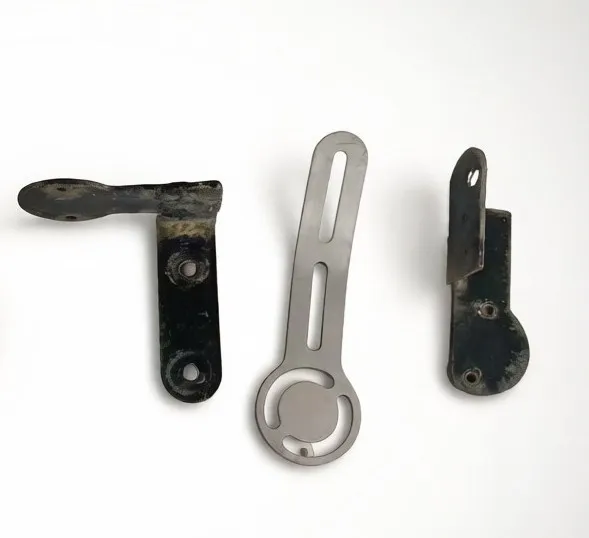
An air-suspension ride-height sensor bracket is a good example. The bracket positions and connects the sensor that tracks changes in vehicle height. Differences in chassis layout, model year, factory mounting points, sensor location, and control-arm geometry can all change the hole pattern, angle, or clearance the bracket requires.
A conventional bracket may start as a piece of steel that is measured, cut, bent, welded, drilled, ground, and finished. The method works, but in a low-volume aftermarket environment, each new variation can send the team back through the same cycle of fabrication and test fitting. The challenge is not whether a bracket can be made. It is whether it can be adapted quickly and accurately—and whether the work invested in one vehicle can carry forward to the next.
Turning Shop-Floor Know-How into a Digital Part
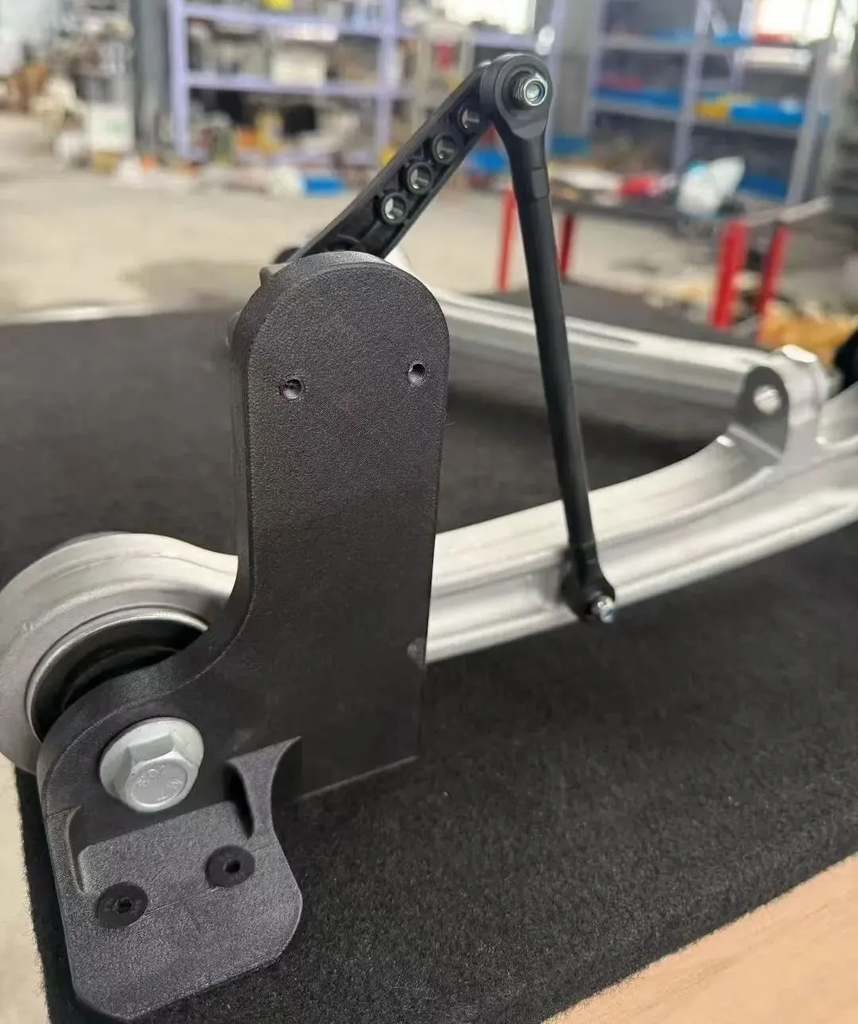
For a Toyota Crown air-suspension project, Beijing-based DGM needed a vehicle-specific ride-height sensor bracket within three days. The team captured the available space, chassis geometry, and factory mounting points, then designed the bracket around the sensor position and its range of motion.
Hole locations, angles, and installation clearances that would otherwise be refined by hand could now be defined directly in CAD. Where the vehicle geometry allowed, DGM also used existing factory mounting points to reduce the need for additional drilling or welding.
That digital model changed more than the production method. It changed the life of the design. When the vehicle, model year, or sensor configuration changes, DGM can revise parameters and local geometry instead of starting over. Wall thickness, ribs, and other features can also be placed around the actual load path, concentrating material where it contributes most.
72 Hours from Vehicle Data to Installation
Day 1: Capture the mounting location, factory hole pattern, and surrounding clearances; complete the bracket design.
Day 2: Print the bracket on an APLUS Blast 2 using Fiberon™ PPS-CF10.
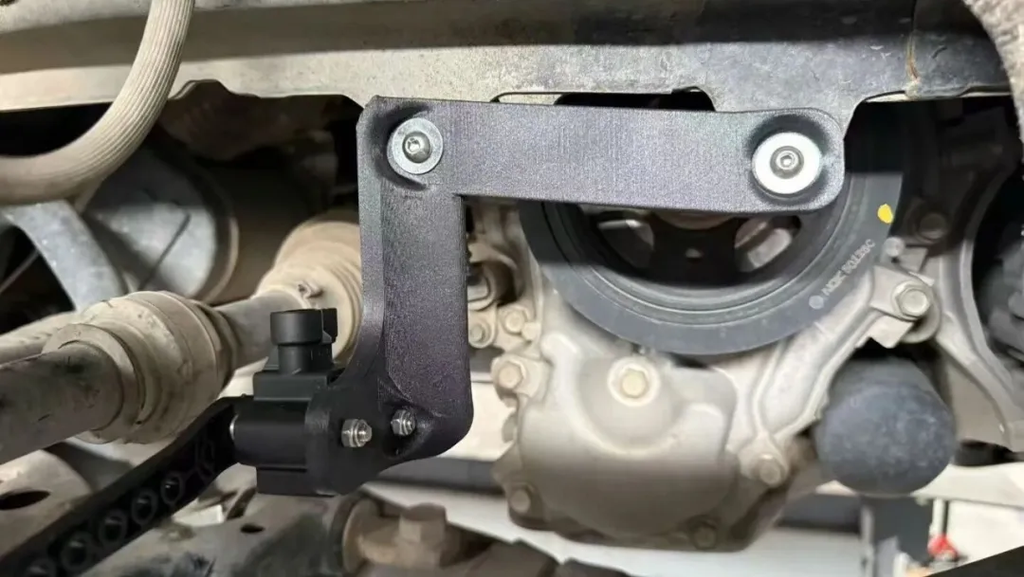
Day 3: Complete the required post-processing, assemble the sensor, and install the bracket on the vehicle.
After installation, the vehicle went through air-suspension height adjustment and functional checks. The printed bracket was installed on the target vehicle and participated in demonstrated air-suspension height adjustment and vehicle operation.
Why Fiberon™ PPS-CF10?
A bracket that fits is only the beginning. Installed near the chassis, it must contend with vibration, cyclic loading, temperature changes, moisture, and road-borne contaminants while helping the sensor maintain its intended position and critical dimensions. Fiberon™ PPS-CF10 gives DGM a strong material foundation for that job.
Stiffness where positioning matters: With an XY tensile strength of 59.4 MPa and a Young’s modulus of 5.45 GPa, the material provides the strength and stiffness needed to support sensor positioning, mounting, and linkage geometry.
More design headroom in hot environments: Heat deflection temperatures of 252.5°C at 0.45 MPa and 133.0°C at 1.8 MPa provide useful screening data for high-temperature applications. The allowable temperature of a finished component must still be validated against its load, geometry, print orientation, annealing process, and intended service life.
Low moisture uptake: An equilibrium moisture absorption of 0.225% helps limit moisture-related changes in dimensions and performance. Compatibility with oils and other substances present in the actual installation environment should be confirmed for the specific application.
Lightweight design potential: At a density of 1.29 g/cm³, Fiberon™ PPS-CF10 gives designers room to reduce unnecessary mass through ribs, localized wall thickness, and geometry optimized for the part’s function.
How One Vehicle Became a Multi-Model Workflow
The Toyota Crown was not a one-off demonstration. DGM has repeated the same workflow – vehicle data capture, digital design, PPS-CF10 printing, installation, and functional validation—across multiple vehicles and models.
Some platforms use a more complete set of printed brackets. Others combine printed components with metal hardware, allowing each manufacturing method to do the job it is best suited for.
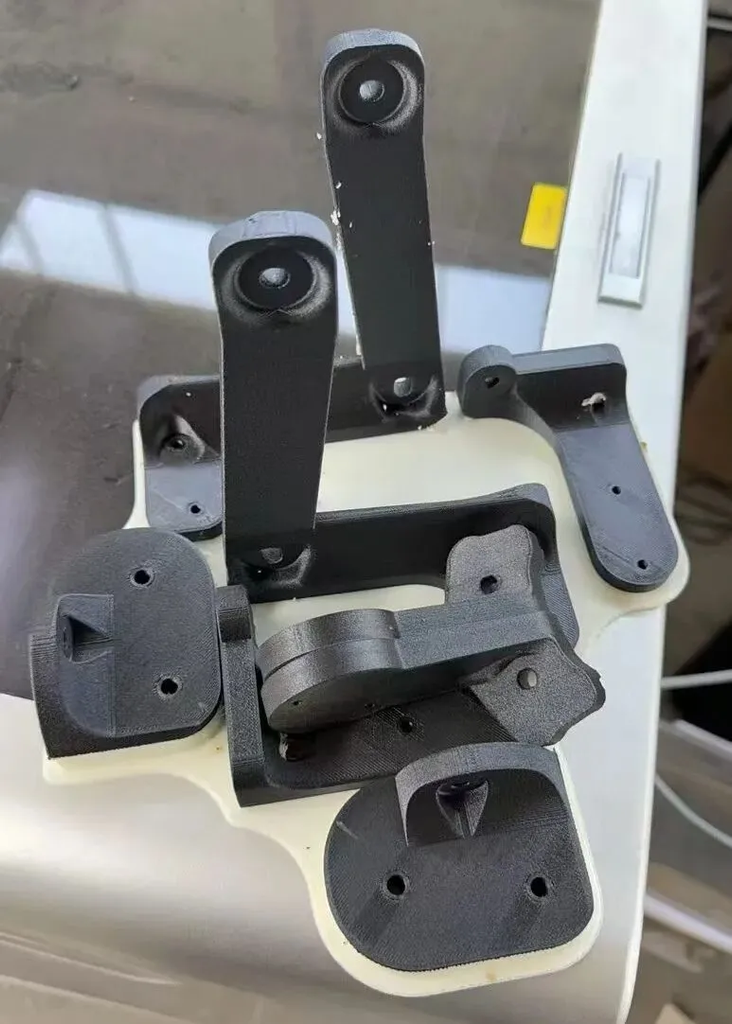
DGM has since adapted the workflow across multiple vehicle platforms, using printed and hybrid printed-metal bracket configurations according to each application.
Could This Workflow Fit Your Application?
This approach is especially relevant to automotive aftermarket developers, custom shops, print service providers, and manufacturers evaluating low-volume functional components with one or more of the following characteristics:
- Mounting points, angles, or packaging space vary between vehicles or equipment versions.
- Individual volumes are low, but the number of models, variants, or SKUs is high.
- The part requires repeated test fitting, revision, and design iteration.
- Existing mounting points are preferred to minimize changes to the original structure.
- The component performs a positioning, mounting, connecting, or protective function.
- The operating environment includes heat, vibration, moisture, oils, or other demanding conditions.
For applications like these, FDM does more than shorten a single production cycle. Once a design has been validated, the knowledge stays in the digital file, ready to be adapted for the next model or customer. Fiberon™ PPS-CF10 helps move that part from geometric fit toward material performance suited to the operating environment.
Start with Your Next Functional Part
Already know what your printer and application require? Explore Fiberon™ PPS-CF10 product information, the TDS, and printing guidance to assess whether it fits your setup.
Still comparing materials or manufacturing routes? Share your part image or CAD file, mounting location, operating temperature, load and vibration conditions, email, and expected volume with the Polymaker team. We can help you evaluate the material and FDM pathway for your automotive or industrial component.